
Why Engineers Compare Concrete Deterioration to Swiss Cheese
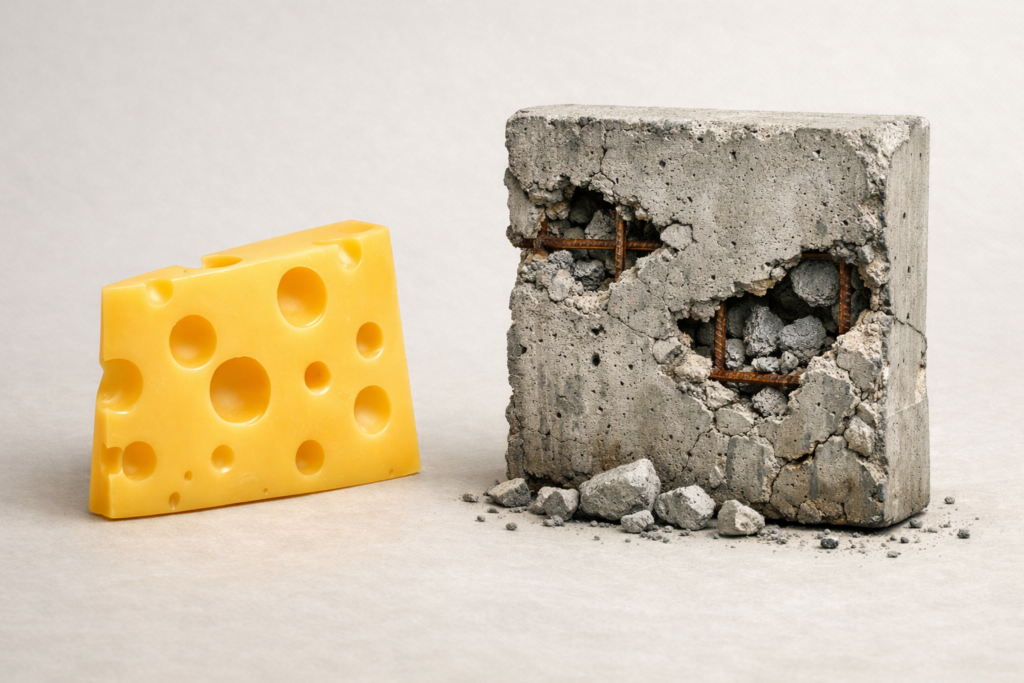
Understanding concrete deterioration in aging buildings
When structural engineers evaluate aging concrete buildings, one of the simplest ways to explain deterioration is with an analogy many people understand immediately.
Imagine a slice of Swiss cheese.
Each hole in the cheese represents a location where material is missing.
In concrete structures, those “holes” are similar to spalled areas, where concrete has broken away and reinforcing steel has begun to corrode.
As deterioration progresses, more of these voids appear. Over time, the structure loses more of the material that provides strength and support.
At a certain point, there is simply less structural capacity remaining.
What is concrete spalling?
Concrete spalling occurs when pieces of concrete break away from a structural element, such as a:
- slab
- balcony
- beam
- column
- parking deck
Spalling typically occurs when reinforcing steel embedded inside the concrete begins to corrode.
Steel expands as it corrodes, which places pressure on the surrounding concrete. This pressure eventually causes the concrete surface to crack and break away.
Once this occurs, the reinforcing steel becomes even more exposed to moisture and air, accelerating the deterioration process.
Why engineers evaluate “demand vs. capacity”
When evaluating concrete repairs, structural engineers often refer to a concept called Demand vs. Capacity.
In simple terms:
Capacity ≥ Demand
Capacity refers to the structural strength of a member.
Demand refers to the loads the structure must carry, including:
- dead loads (the weight of the structure itself)
- live loads (people, furniture, vehicles, etc.)
As deterioration progresses and materials are lost, capacity decreases.
If capacity drops too close to demand, the safety margin becomes smaller.
This is why structural engineers carefully evaluate the extent of deterioration when recommending repairs.
Why early repairs matter
One of the most important things building owners should understand is that the threshold for repair is not high.
Damage does not need to be severe or dramatic before it should be addressed.
Early repairs help:
- preserve structural capacity
- reduce future repair costs
- prevent deterioration from accelerating
Addressing deterioration early is almost always more cost-effective and less disruptive than waiting until damage becomes extensive.
Signs your building may need evaluation
Common indicators of concrete deterioration include:
- cracking
- rust staining
- exposed reinforcing steel
- spalling or delaminated concrete
- water intrusion near structural elements
If these conditions are present, a structural evaluation may help determine the appropriate next steps.
Final thought
Concrete deterioration is often gradual and can be difficult to notice in its early stages.
But just like a slice of Swiss cheese becomes weaker as more holes appear, a structure can lose strength as deterioration progresses.
Early evaluation and targeted repairs help preserve both the safety and longevity of a building.
If you’re noticing cracking, rust staining, or spalling concrete in your building, it may be time for a structural review.
Our team can help evaluate existing conditions and recommend the appropriate repair strategy for your property.
Learn more at upefl.com or contact us at info@upefl.com to discuss your upcoming restoration needs.