
Why Florida’s Definition of “Substantial Structural Deterioration” Needs Another Look
By UPE President, Carmelo Giglio, PE, SI, FRSE, CGC, CSI-CDT
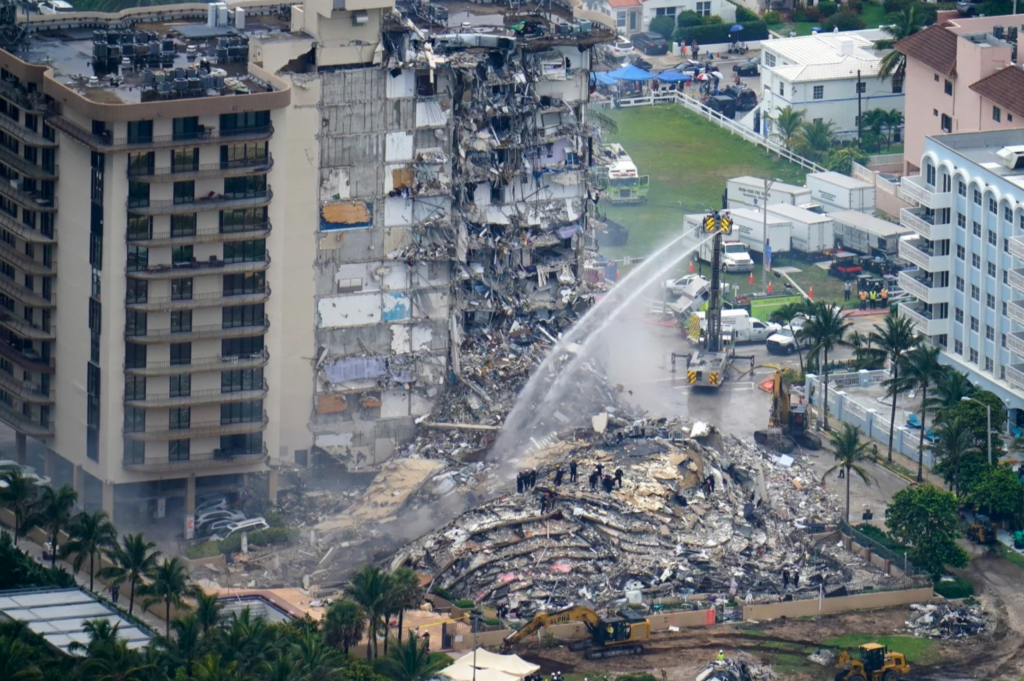
One aspect of Florida’s milestone inspection statute that I have repeatedly criticized in my presentations is the statutory definition of “substantial structural deterioration.” With the recent release of the NIST report on the Champlain Towers South collapse, I believe those concerns are even more relevant today.
Watch Carmelo Giglio, PE, SI, explain why the definition of substantial structural deterioration matters and how it has created confusion for milestone inspections.
The Current Definition Raises Concerns
The current definition states that substantial structural deterioration does not include surface imperfections such as cracks, distortion, sagging, deflections, misalignment, signs of leakage, or peeling finishes unless the engineer or architect determines that those conditions are signs of substantial structural deterioration.
One of my greatest concerns is that the statute categorizes cracks, distortion, sagging, deflections, misalignment, and signs of leakage as surface imperfections. In my opinion, that characterization is fundamentally incorrect. These are not surface imperfections in the engineering sense. They are observable indicators of structural behavior that may signal underlying structural distress. While these conditions may ultimately prove to be insignificant after evaluation, they should never be categorized alongside cosmetic conditions such as peeling paint or other finish-related defects. By placing these conditions under the umbrella of “surface imperfections,” the statute risks minimizing the importance of some of the very warning signs that engineers, property managers, board members, and owners should be trained to recognize and investigate.
While the statute does provide an important exception by allowing the engineer or architect to exercise professional judgment, I believe the language sends the wrong message. It suggests that many of the very warning signs engineers, property managers, board members, and owners should be paying attention to are somehow less significant.
What This Means for Phase 1 Milestone Inspections
We know that many engineers are passing Phase 1 milestone inspections even though a building needs repairs. While not every building requiring repairs has substantial structural deterioration, it raises an important question: Are some engineers being influenced by a definition that appears to minimize visible signs of structural distress?
Lessons From Champlain Towers South
Ironically, many of these same conditions were present at Champlain Towers South. The NIST investigation documented significant cracking, movement, and misalignment of the pool deck planters, and water intrusion at the columns where the collapse began. These were not merely cosmetic defects: they were visible symptoms of an underlying structural problem.
The question we should be asking is: How is an engineer, owner, or manager supposed to recognize that a building may have a serious structural problem?
The answer is by observing warning signs such as:
- Significant cracking
- Excessive deflection or sagging
- Structural misalignment or movement
- Persistent water intrusion around structural elements
- Progressive distortion of structural components
These are precisely the conditions that should trigger concern and further investigation.
Visible Distress Should Trigger Further Evaluation
Of course, not every crack or leak represents substantial structural deterioration. Professional judgment is essential. However, the statutory definition should emphasize that these observable conditions are often the first indicators of serious structural distress, rather than beginning with a statement that they are excluded.
In my opinion, the current definition is poorly worded and has the potential to create confusion for owners, board members, managers, and even engineers who may incorrectly conclude that visible structural distress is of lesser importance. The lessons learned from Champlain Towers South demonstrate exactly the opposite. Visible structural distress is often the earliest warning that something much more serious is occurring beneath the surface.
Final Thoughts
The statutory definition of “substantial structural deterioration” should not discourage attention to visible structural warning signs. It should encourage it. The events leading to the Champlain Towers South collapse remind us that cracks, deflection, distortion, misalignment, and water intrusion are often the very clues that warrant further investigation. It is time to revisit this definition and revise it so that it reflects sound engineering principles and promotes the recognition of these critical warning signs rather than appearing to dismiss them.
If your condominium association has visible cracking, deflection, water intrusion, or other signs of structural distress, UPE can help provide the professional engineering guidance needed to evaluate the issue and determine the appropriate next steps. Contact our team to discuss your building’s needs.