
Why Do Concrete Repairs Cost So Much?
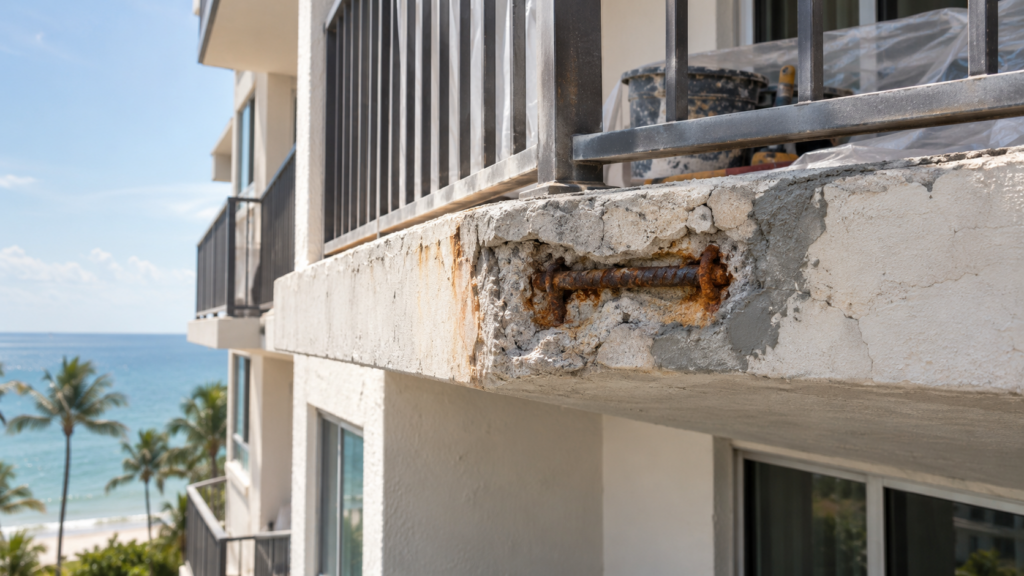
One of the greatest challenges we continue to face in condominium restoration projects is helping boards and owners understand the actual cost of concrete repairs.
Since the Surfside tragedy and the resulting increased focus on aging condominium buildings, associations throughout Florida have been forced to confront repairs that may have been deferred for many years. Unfortunately, these repairs can be expensive—particularly for communities with retirees, owners on fixed incomes, or properties where large assessments are difficult to absorb.
We understand the financial impact. At the same time, there needs to be a realistic understanding of what this type of construction costs today.
A Simple Balcony Example
Consider a relatively ordinary 20-foot-wide by 5-foot-deep balcony requiring approximately 30 linear feet of concrete edge repair.
At an illustrative unit price of $160 per linear foot, the concrete edge repair itself would cost approximately $4,800. Add a relatively small amount of full-depth slab repair, and the direct concrete work might total approximately $5,400.
But the concrete is only part of the repair.
The contractor may need to remove and reinstall the balcony railing. Hurricane shutters and tracks may need to be removed, stored, and reinstalled. Waterproofing and the decorative coating or spray deck must be restored. Stucco and paint at the repaired surfaces must also be restored.
Using reasonable illustrative unit prices, our simple balcony might look something like this:
– Concrete edge repair: $4,800
– Additional full-depth concrete repair: $600
– Railing removal and reinstallation: $1,650
– Shutter and track removal, storage and reinstallation: $1,600
– Waterproofing and spray deck restoration: $2,000
– Stucco restoration: $1,925
– Painting of repaired surfaces: approximately $165
The direct construction cost is now approximately $12,740.
Then there are costs necessary to actually perform the project: mobilization, staging and access, and contractor general conditions. Allowing approximately 5% for each brings this simple example to roughly $14,650 for one balcony.
And that does not include engineering, permitting, special inspection, unforeseen deterioration, or other project-specific conditions.
Don’t Think in $5, $20 or even $100 Increments
Another important concept for owners and boards to understand is the scale at which restoration costs need to be considered.
Concrete restoration cannot realistically be evaluated in increments of hundreds of dollars—or even necessarily $1,000.
It is more realistic to think in increments of $5,000, $10,000, $15,000, $20,000, and beyond.
Is this a $5,000 repair? A $10,000 repair? A $15,000 repair?
That is often the appropriate scale.
We sometimes see owners scrutinizing restoration budgets as though eliminating relatively small individual items will fundamentally change the overall economics of the project. Certainly, engineers and contractors should look for legitimate opportunities to control costs. But owners also need to recognize the magnitude of the work being performed.
Even painting a building today can represent a significant cost. Structural restoration involving demolition, corrosion removal, reinforcing steel, concrete placement, waterproofing, coatings, and difficult access is simply not a thousand-dollar-per-unit undertaking in many buildings.
This Is Not Ordinary Construction
Consider what it costs today simply to have a plumber come to your home to replace a toilet or sink.
Now compare that with structural concrete restoration.
Workers may be suspended several stories above the ground on swing stages. Access is limited. Materials and debris must be moved safely into and out of occupied buildings. Existing conditions are frequently concealed until demolition begins. Workers are removing deteriorated structural material, exposing reinforcing steel and rebuilding portions of a structural system.
There is significant labor, specialized equipment, safety responsibility, and liability involved.
This isn’t the same as performing construction at ground level on a new building where everything is readily accessible.
Restoration is specialized work performed under difficult conditions.
Think About a Cavity in a Tooth
I have often used a dental analogy to explain concrete restoration.
When you have a cavity, the dentist cannot simply place a filling over the visible hole.
The dentist has to remove the deteriorated material until reaching sound tooth structure. Only then can the tooth be restored with a material intended to return it to a serviceable condition.
Concrete repair is similar.
What you see at the surface does not necessarily define the limits of the repair.
The contractor must remove deteriorated concrete until sound material is reached. Reinforcing steel must be exposed sufficiently to evaluate its condition. Active corrosion needs to be addressed. Only after the deteriorated material has been properly removed and the underlying conditions addressed can the concrete be restored.
And just like a dentist, different engineers may have different opinions regarding exactly where those limits should be.
At UPE, we believe our professional standard of care requires us to recommend repairs that adequately address the deterioration and active corrosion we identify so that the repair has a reasonable opportunity to perform and last.
Doing thorough work costs money.
The Concrete Isn’t Always the Expensive Part
Our simple example illustrates another important point.
The actual concrete work was approximately $5,400, yet the complete repair approached $14,650.
A substantial portion of the cost had nothing to do with simply placing concrete. It was the work required to access the deterioration, remove interfering components, perform the repair safely, restore stucco, waterproofing, and finishes, and put everything back together.
Multiply that across dozens—or hundreds—of balconies, walkways, columns, beams, and other structural components, and it becomes much easier to understand how condominium restoration projects can reach hundreds of thousands or millions of dollars.
Be Careful of an Estimate That Seems Too Good to Be True
There is another reason we believe it is important for boards and owners to understand the realistic cost of concrete restoration: it makes it easier to recognize an estimate that may simply be too low.
As we discussed in a recent article, associations should be cautious when one engineer’s anticipated repair cost is dramatically lower than what other experienced restoration professionals are suggesting.
Sometimes an engineer may simply underestimate the extent of the deterioration or fail to account for all of the incidental work required to complete the repairs. They may not fully appreciate the costs of railings, shutters, stucco, waterproofing, coatings, staging, access, and general conditions.
In other situations, an unrealistically low estimate may make a project appear more financially attractive to a board during the selection process. The problem is that once construction begins and the actual quantities and necessary scope become apparent, the association may discover that the project is considerably more expensive than originally represented.
By then, the association may already have retained the engineer, completed the design, hired a contractor, and begun construction.
That is why boards should not automatically view the lowest repair estimate as the best news.
If several experienced restoration professionals are telling you that a project is likely to cost $1 million and someone else tells you it will cost $400,000, the question should not simply be, “Why are the others so expensive?”
The equally important question is: “What might be missing from the $400,000 estimate?”
Understanding what concrete restoration actually costs gives boards another tool to evaluate these estimates intelligently and avoid being surprised after construction begins.
Don’t be fooled by a number simply because it is the number everyone wants to hear.
Expensive Does Not Mean Unnecessary
We recognize how difficult these numbers can be for condominium owners, particularly retirees and those living on fixed incomes.
But structural deterioration does not become less serious because repairing it is expensive.
Our responsibility as engineers is not to make a repair estimate fit a predetermined budget. Our responsibility is to identify the deterioration, exercise professional judgment, recommend appropriate repairs, and perform our services consistent with a reasonable professional standard of care.
We should always look for practical and cost-conscious solutions. But there is an important difference between controlling costs and reducing a repair scope below what is reasonably necessary to address deterioration and active corrosion.
The purpose of this article is not to convince anyone that nearly $15,000 for a balcony is inexpensive.
It isn’t.
The purpose is to help owners understand why it can cost that much.
Concrete restoration is expensive. Specialized labor is expensive. Access is expensive. Safety is expensive. Stucco, waterproofing, coatings, railings, and shutters are expensive. And properly addressing deterioration and active corrosion takes time and money.
The sooner an association understands the realistic magnitude of these costs, the better equipped its board and owners will be to budget for the work, evaluate proposals intelligently, and make responsible decisions about the future of their building.
If your condominium or property is planning concrete restoration work, United Professional Engineering can help you better understand the scope, priorities, and next steps.
Contact UPE to discuss your upcoming concrete repair or restoration project.